


One of the hardest things to learn — and one of the things that comes up again and again in guided BeMo Practice sessions — is that love and responsibility are not the same thing.
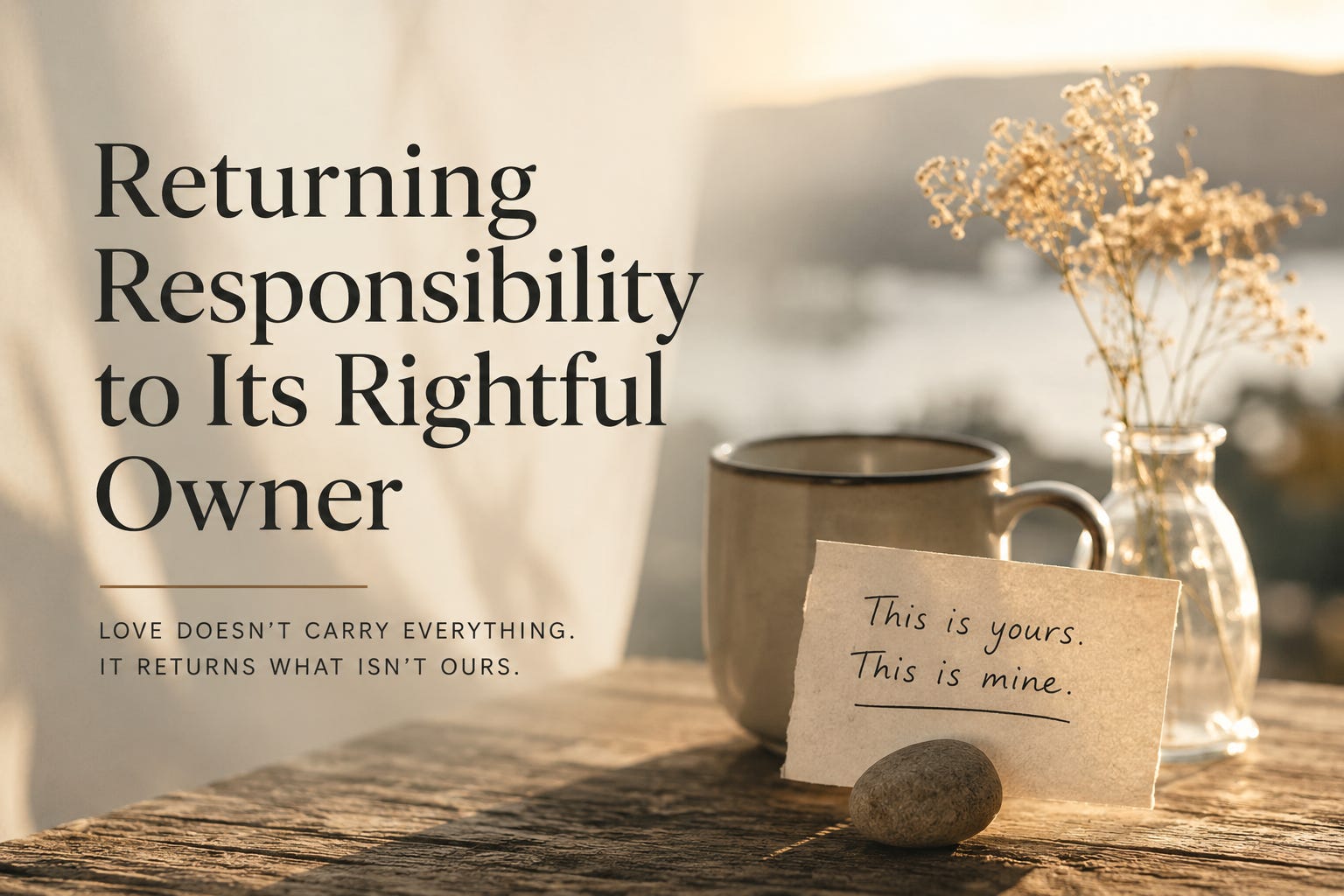
For a long time, many of us believed that loving someone deeply meant carrying more.
We carried the emotional labor.
We carried the remembering.
We carried the planning.
We carried the awareness.
We carried the conversations nobody wanted to have.
We carried the consequences of things that were never ours — because it felt easier than watching someone we loved struggle beneath them.
It felt like protection.
It felt like devotion.
It felt like love.
But eventually, something began to feel heavy.
Not because we loved them less.
Because we were carrying things that never belonged to us.

The Difference Between Supporting and Carrying
There is a distinction that doesn’t get talked about enough, and it’s one that changes everything once you see it.
Supporting says:
“I am with you.”
“I believe you can hold this.”
Carrying communicates:
“I will do it for you.”
“I don’t believe you can.”
Sometimes we carry because we are afraid.
Afraid they will fail.
Afraid they will suffer or be embarrassed.
Afraid they will leave.
Afraid that if we stop compensating, everything will collapse.
Sometimes, the people we love become so accustomed to us carrying things that the moment we set them down, it feels like abandonment.
But setting down what isn’t ours isn’t abandonment. It’s truth. It’s trust. It’s Knowing that another person is capable of doing hard things and facing difficult emotions, hard conversations, and life’s ebbs and flows. It’s Knowing we are safe regardless of what others close to us choose for themselves.
This is perhaps the most difficult thing to add to your Knowing. It’s something that can change everything, as I found in my own healing journey and recently started to write about here:


When Accountability Gets Confused for Criticism
Here’s where it gets complicated.
When we finally start to set things down, we often don’t do it in silence. We name it. We say, "This isn’t mine." I’ve been carrying this, and I can’t keep doing it.
And sometimes, the person we say it to hears something very different.
They hear judgment.
They hear rejection.
They hear: You are broken. You are a problem. You have failed me.
This is the place where we have a need for honesty:
There is a difference between abusive criticism and healthy accountability.
And that difference matters — not just for the person receiving it, but for the person saying it.
Abusive criticism says:
“You are the problem.”
“Something is wrong with you.”
“You need to become different for me to be okay.”
“I will keep pressing until you agree with me.”
Holding someone accountable says:
“This is yours.”
“This is the impact it has on me.”
“This is what I am no longer willing to carry.”
“What you do with that information is your choice.”
The distinction is not about whether someone feels hurt.
People can feel hurt by accountability.
People can feel shame when no shame was intended.
People can feel criticized when someone simply names reality.
The distinction is where the responsibility lands.
Abusive criticism tries to make the other person responsible for your Feelings – your regulation, your worth, or your happiness.
Healthy accountability returns responsibility to its rightful owner.

A Real-World Example
Here’s the difference in practice:
Abusive criticism:
“You never show up for me. You’re never there. I always have to…”
Healthy accountability:
“Hey, I want to ask you about something. And maybe I am misunderstanding things here because it isn’t what I’m used to, but I feel hurt and sometimes a little disregarded when I tell you about something really difficult for me, and it just seems shrugged off as no big deal. You are important to me. I have a need for connection in that moment; for being shown up for. I stop feeling safe in that connection when it happens consistently. Can you tell me what’s going on for you in that moment? I’d love to know.”
One attacks identity.
The other describes behavior and, in very difficult conversations, consequences.

The Question That Helps
When I’m in the thick of it — when something feels urgent, when I need to say something, when I can feel myself reaching toward the other person — the most honest question I can ask isn’t about them at all.
It’s this:
“What need am I trying to meet right now — and am I trying to meet it from within, or am I trying to get them to meet it for me?”
Because here’s what I’ve learned:
You are not your partner’s therapist.
You are not responsible for their growth.
And they are not responsible for your regulation.
When your needs are met within a relationship, when that need is met by someone else, that is a gift. It is the icing on the cake and the cherry on top. But it will never replace the need to overlook meeting your own needs.

Since creating The BeMo Practice, I’ve been great at meeting my needs. I’ve utilized the hyper-independence that came from trauma to create a ladder to climb out of holes created by learned behaviors and victim/hero/martyr mentality. Every time I practiced, I did better. I learned more. I practiced the very things that would help me let go of the rigid clutch on hyper-independence and instead open up to the vulnerability necessary for true connection. I started to become increasingly grateful for the “cherry on top” needs met through connecting with others – laughter in friendship, a listening ear, a cooked meal, a cleaned house, and so much more. But here’s the crux, what you Know may not yet be what someone else knows or is growing toward. That is not your journey. It is not your responsibility. When you lay down what you once thought was protection and instead churn up more of a fight, it can feel overwhelming and entirely confusing. It doesn’t mean you did it wrong. It doesn’t mean the protection is gone. It doesn’t mean the responsibility is yours. It means you’ve entered a new level of your healing journey and found new growing pains.


When we walk into a hard conversation hoping the other person will finally see, finally get it, finally validate what we’ve been experiencing, we’ve already externalized something that was ours to hold.
That’s not a character flaw.
That’s a very human thing to do.
But it creates chaos.
Every time.
Because the moment your sense of resolution, connection, or safety depends on what someone else does with what you say, you’ve handed the keys to your nervous system over to someone who was never meant to have them.
The need for connection is real.
The need to show up honestly in your relationships is real.
But meeting those needs begins within.
It begins with asking:
Am I connected to myself right now?
Am I showing up from a grounded place, or a desperate one?
Am I speaking because I am meeting a core need by honoring what’s true for me — or because I need them to respond in a specific way for me to feel okay?
If the answer is the latter, the conversation isn’t ready yet.
Not because you don’t deserve to have it.
But because you deserve to have it from solid ground.

What You Can Say Instead
If you’ve been struggling to find language that is honest without being harmful, here’s something to try:
“I Know that some of what I say may sound similar to criticism you’ve experienced before. I understand why that would be painful.
But my intention isn’t to convince you that you’re bad or broken. My intention is to be honest about what I experience, what affects me, and what I can and cannot continue carrying.”

When Pain Recognizes Itself Before It Recognizes Reality
The hardest part of all of this is something that deserves its own space.
Sometimes, people who have been deeply criticized in life experience accountability as criticism.
Sometimes, people who have spent years over-functioning for others experience boundaries as cruelty.
Neither experience automatically tells us what is actually happening.
The question isn’t: “Do they feel criticized?”
The question is: “Am I asking them to carry what is theirs, while carrying what is mine?”
If the answer is yes, then you may still be loving someone deeply — while refusing to continue protecting them from the consequences of their own choices.
That isn’t abandonment.
It’s the place where love stops rescuing and starts respecting another person’s responsibility.

Love Doesn’t Ask Us to Abandon Ourselves
Love doesn’t ask us to rescue someone from every consequence.
Love doesn’t ask us to carry another person’s half forever.
Sometimes love asks us to stand beside someone and trust that they are capable of carrying what is theirs.
Even when they don’t believe it.
Even when they wish we would continue carrying it for them.
Even when they mistake our boundary for a withdrawal of love.
Because the deepest form of love is not always protection.
Sometimes it’s respect.
Sometimes it’s trust.
And sometimes it’s finally setting down the weight that was never ours to carry.

Take It Into Your BeMo Practice
This week’s BeMo prompt invitation:
Think of something you’ve been carrying in a relationship that may not be yours.
Use your BeMo Journal to explore:
What are you carrying that belongs to someone else?
What fear is underneath your willingness to keep carrying it?
What would you need to believe about them — and yourself — to set it down?
What’s the difference between the accountability you want to offer and the control you might be reaching for?
You don’t have to have the answer right away. That’s what the practice is for.

Want to Go Deeper?
Cassandra shares the more personal, behind-the-scenes side of navigating these exact dynamics — including what it looks like when the people we love are dealing with wounds that make accountability feel like an attack — over on her personal Substack 👉 CassandraStark.Substack.com
It’s raw, it’s real, and if you’ve ever wondered “how does she actually use BeMo in her own life?” — that’s where you’ll find it.

If this piece resonated with you, you’re exactly who this space was built for.
The #BeMoJo Community is a place for people who are done just understanding their patterns — and are ready to actually shift them. Through guided BeMo journaling events, honest conversations, and a community of people who get it, we go further together than we ever could alone.
Here’s what’s waiting for you when you subscribe:
✅ Free tools and guided BeMo Practices
✅ Behind-the-scenes insights and community conversations
✅ Access to live journaling events and replays
✅ A space where growth is honored, and you don’t have to carry it alone
Join the BeMo Community → Get live guided BeMo Practice sessions FREE every month
A space for self-discovery, emotional growth, and grounded connection — one journal entry at a time.
Because healing shouldn’t be lonely.
And you were never meant to carry all of this by yourself.